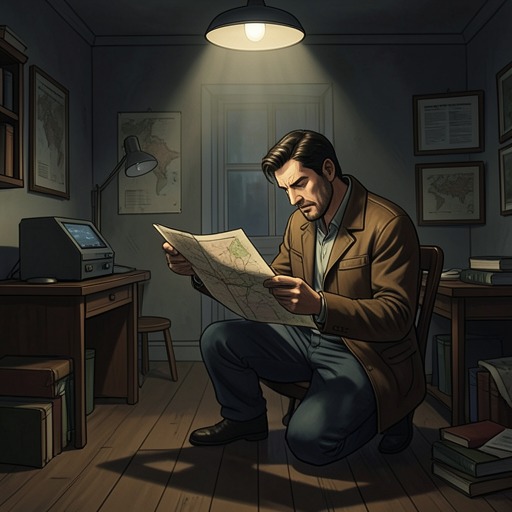
Simon Fisher
The Hanging GirlSimon Fisher is a former associate of Frank Brennan whose recollections help Carl Mørck trace Frank’s spiritual development and whose later encounter with the investigators gives that history a living witness. The novel presents him in two complementary ways: as the man remembered alongside Frank during the formation of a personal spiritual philosophy, and as a practitioner of alternative therapies with a garden-center connection in Holbæk. His account links Frank’s ideas to their shared summer at Ølene and to the ancient sun offerings uncovered at Rispebjerg, while also revealing a difference between the two men that their conversations could accommodate without ending their friendship.
Identity and Introduction
Simon first enters the investigation through an alternative therapist’s recollection of Frank’s companion. Frank, the therapist recalled, was assembling his own spiritual philosophy by collecting ideas he found useful and combining them. He described the man with him as a witness of truth. The therapist remembered that this companion was Simon Fisher; the name prompted laughter among those recounting it, who found it unusually apt to a pairing they characterized as a messiah and a follower. That characterization belongs to the therapists’ interpretation, not to a declaration by Simon himself.
The same recollection adds a concrete detail about Simon’s interests: he paid close attention to a therapist’s garden of medicinal plants and said he would like a garden of his own. The account connects that wish to a garden center in Tempelkrogen, an area of Holbæk. This reported outcome gives Simon a practical counterpart to the spiritual and therapeutic interests through which he is introduced. The evidence identifies the garden center as his, though it does not explain when or how he established it.
Frank Brennan and the Ølene Summer
When Carl meets Simon, he explains that the investigators found him through an alternative therapist whom Simon and Frank had visited together. Simon confirms that he spent the whole summer at the Ølene camp and remembers the period warmly. He says that he and Frank had a difference of opinion, but that their conversations were nevertheless excellent. The distinction matters: Simon’s account neither makes them doctrinally identical nor reduces their connection to disagreement. Their exchange of ideas could continue across a difference.
Carl asks whether their discussions concerned sun cults and religion. Simon confirms those subjects, adding that they ranged much more widely. His recollection supplies a personal context for the earlier report that Frank was constructing a syncretic spiritual philosophy: Frank did not develop these interests in isolation, but discussed religion and related questions with Simon during their time together. Simon’s evidence is that of a participant and companion, not a formal account of Frank’s teachings; the conversation establishes the subjects and the relationship, without specifying every idea they debated.
Rispebjerg and the Sun Offerings
Simon also recalls that he and Frank both took part in excavations at Rispebjerg. The site held particular importance for Frank, who felt an attachment to its sun offerings and to evidence of powerful cultures that had existed there thousands of years earlier. Simon’s recollection therefore ties Frank’s modern spiritual interests to a material archaeological setting: the sun was not only a topic of conversation but part of the ancient remains that the two men encountered through excavation.
The memory is not wholly reverential. Simon says, with a laugh, that Frank stole one of the sunstones they excavated, then lowers the tone of the admission by saying they discuss it only under their breath. The brief anecdote complicates the image of Frank as a seeker of spiritual meaning: the sacred or historically charged object also becomes evidence of a concealed act. Simon’s laughter stops when he catches his wife’s eyes. That small change in the scene marks a limit on his ease in telling the story, though the passage does not explain her response or Simon’s reason for checking himself.
Therapeutic Practice and Narrative Role
In a later encounter, Simon attends to Assad’s sleeplessness by recommending herbs, then turns to Carl and gives Assad a pendulum with a brief explanation of its use. The room around this exchange is described as crowded with mismatched, worn furnishings and posters that place Hindu gods beside framed Danish nature images. Simon opens a drawer in an old bureau before producing the pendulum. These details situate his practice among eclectic spiritual and alternative-healing materials rather than presenting it as a continuation of the archaeological work at Rispebjerg. His specific actions in the scene are modest but concrete: he offers herbs for Assad and introduces him to the pendulum.
Simon’s appearance also carries the investigation beyond the therapists’ recollections into contact with someone who knew Frank directly. He confirms the Ølene connection, supplies the excavations and the stolen sunstone as particular memories, and acknowledges both closeness and disagreement. Separately, a later telephone exchange shows him contacting Pirjo Abanshamash Dumuzi after a long interval and asking whether everything is all right. Pirjo recognizes him and is puzzled by his tone, thinking that Simon is not especially perceptive and wondering whether Birtemaja has sensed something. The scene establishes renewed contact and Pirjo’s uncertainty about why he called, but it does not disclose Simon’s reason. Across these appearances, Simon functions as a link between Frank’s earlier spiritual circle and the investigation’s present, while remaining a distinct figure whose own beliefs and motives are only partly described.